
We do not assign scale to a bear or field of boulders, nor danger to a precipice or thousands acre fire—these things have meanings we understand physically—swarming gnats, and eroding embankments are powerful references because we need not ‘make up’ their meanings.
Site can be thought of as an accumulation of event artifacts marking the actions upon a place by forces over time—sometimes geologic, other times cultural. A site is terrain and context but also a voice one can coax into song.
The Kotawa (Keepers of the American Wilderness Act) Project was done with the support of the Also &Leonardo foundation and was organized by Colorado Art Space. To celebrate the 50th anniversity of the Wilderness Act artists were selected to be embedded with research scientists and wilderness ranges in a variety of wilderness settings rom Pueto Rico to Alaska–my own embedded experience was in the High Sierra Alpine region of the John Muir Wilderness Area–here for 30 days I initiated actions with and for my happenstance co-occupants of the biome–human animals plants stone and ice, culminating in an eight days of off trail trekking
I wanted the work directly linked to my excursions into the broad physicality of the biom— The art grappling with conditions and ailments–for art I believe is medicinal at its root.
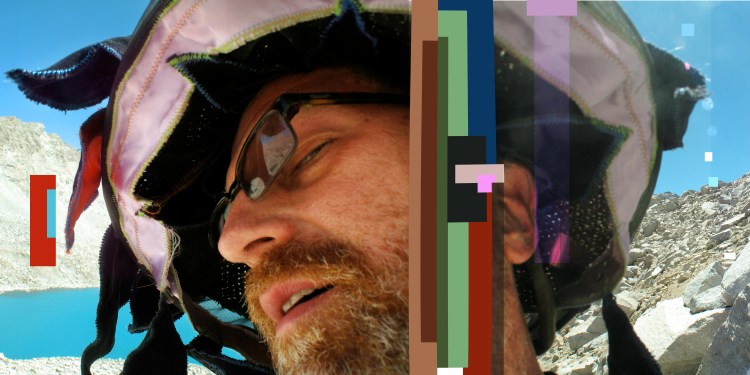
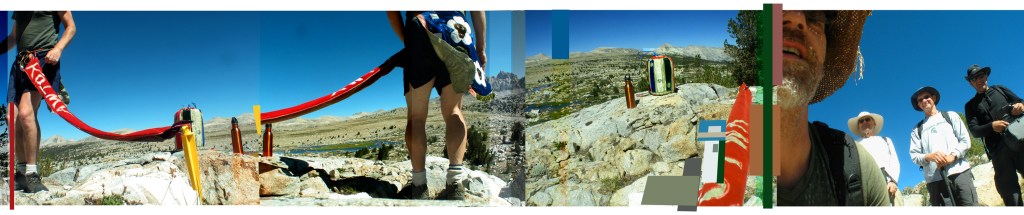
In the Kotawa Project photographic documentation I insert noise in the form of digital blocks of color reminiscent of glitches–these are notations that documentation is a slippery stand-in for the events wherein my art practice resides–these panoramics are fictions that freeze and layer time merge wilderness dream theater

within the spirit of the wilderness acts legal provision is a variety of prohibitions problematic to the prominent modes of the sculptor–No building of structures, No importation, extraction or altering of material resources or leaving behind signs of one’s presence. I began as an embodiment of ‘wilderness character’ and in that spirit I entered and the Wilderness. My guise was Kotwa (keeper of the wilderness act) I began to concoct and perform a series of beliefs and practices that reflected the theatricality I observed being played out by hikers, rangers and myself alike–for within the Wilderness Area I experienced a seemingly unavoidable role-playing –a pretending of a character set against the reality of the severe physical environ struck me as profound in that it revealed the difficulty of a contemporary person residing naturally within wilderness—thus for me a contemporary human visitor, wilderness could not be indigenous place but instead was a stage—an island of fantasy within the pervasive and surrounding non wilderness norm.
I found this deeply troubling, seeing wilderness as a kind of gated community existing by way of legislation, management, bi-laws and standardized taste–in short, intentional artifice. This intentional artifice strongly influenced how I acted within—and I believe I saw this at play in all whom I encountered. This is not true of the wildernesses itself nor for the non-human communities of flora, fauna and geology–free from a self-consciousness regarding boundaries, entry and intent for a true ‘wilderness experience’. Place itself operates in a sort of parallel universe to our experience–a place we can not enter.
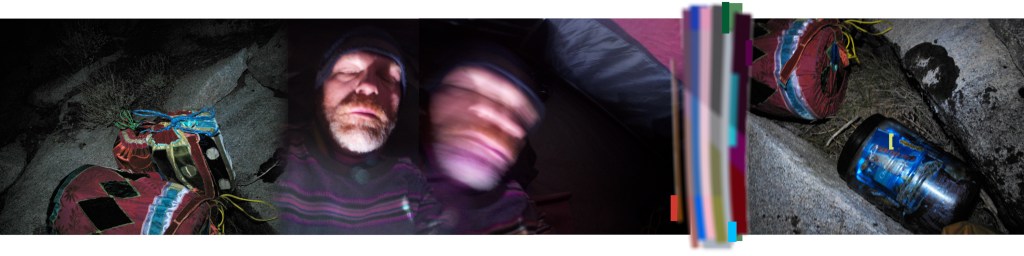
Here it may be of importance to reveal that the Wilderness Act at inception aimed to preserve wilderness for its own intrinsic value–a notion that has been steadily eroded by forces that preference human activities: recreational, scientific, aesthetic and spiritual. I came to see all human use within the wilderness as distraction sometimes bastardizations of the intrinsic value of a wilderness.
Thus the Kotwa performances came to form themselves into two genres, those that reacted to observations—these have titles loosely referring to serial adventure novels. Kotwa and the circus of destruction, An accordian is placed in a bear can—bears are warned in song not to perform like circus bears. Kotwa and the corridor of sacrifice, A cusion is made to replace the trail—embroidered into its surface are fragments of trail food wrappers each is touched when walking the length of the cushion, Kotwa and the defeat of fire, a game of rock paper scissors is played as rock foil, fire—fire always wins, Kotwa and the swarm of the white flowers wearing a loin cloth decorated in brown skulls as a motif, soft absorbant leaves are collected and wrapped in wax paper examples of how to defeat the white flower litter of inadequately buried waste & toilet paper found in many camp sites.
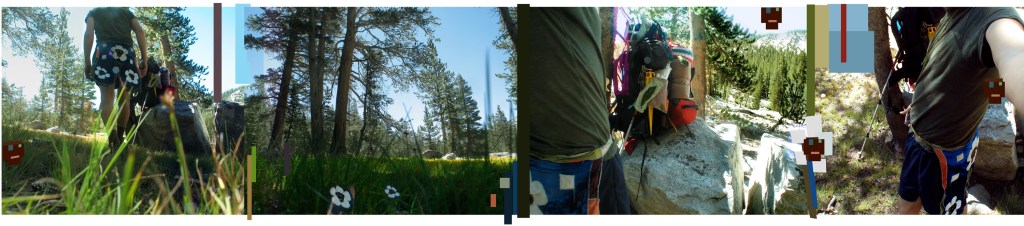

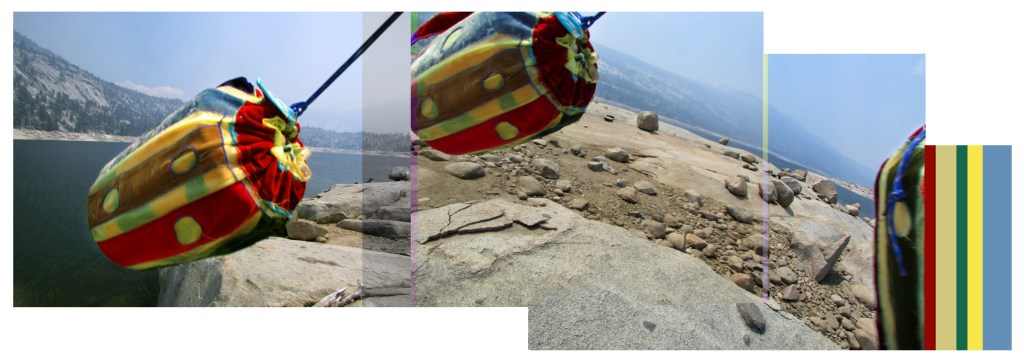
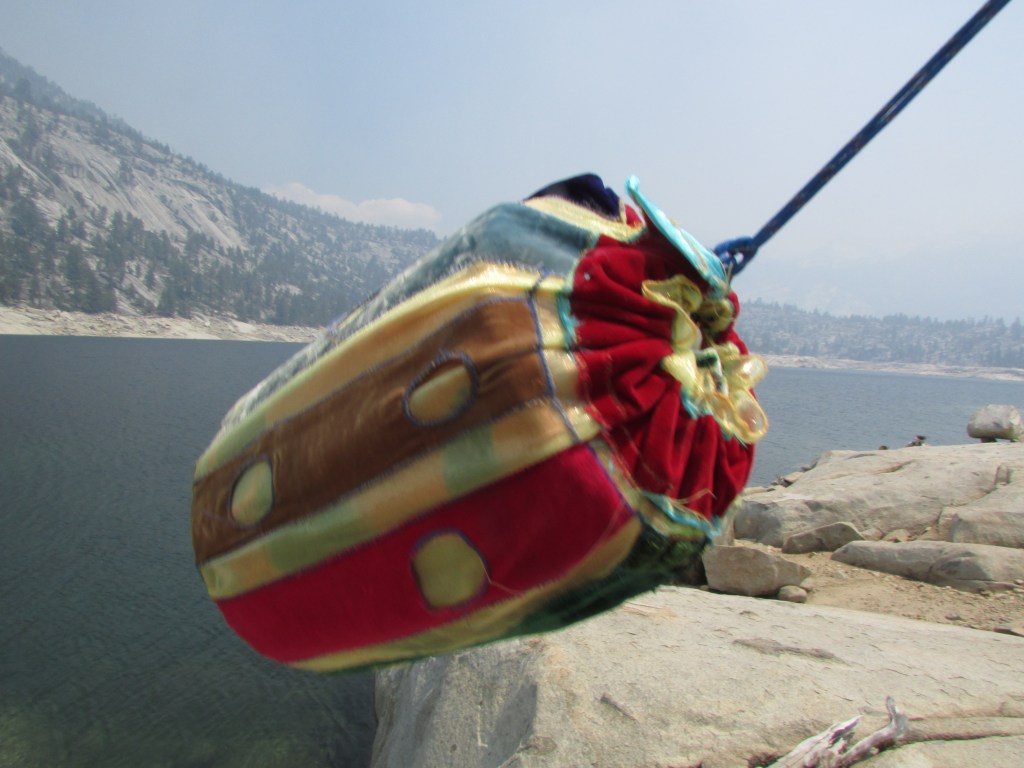
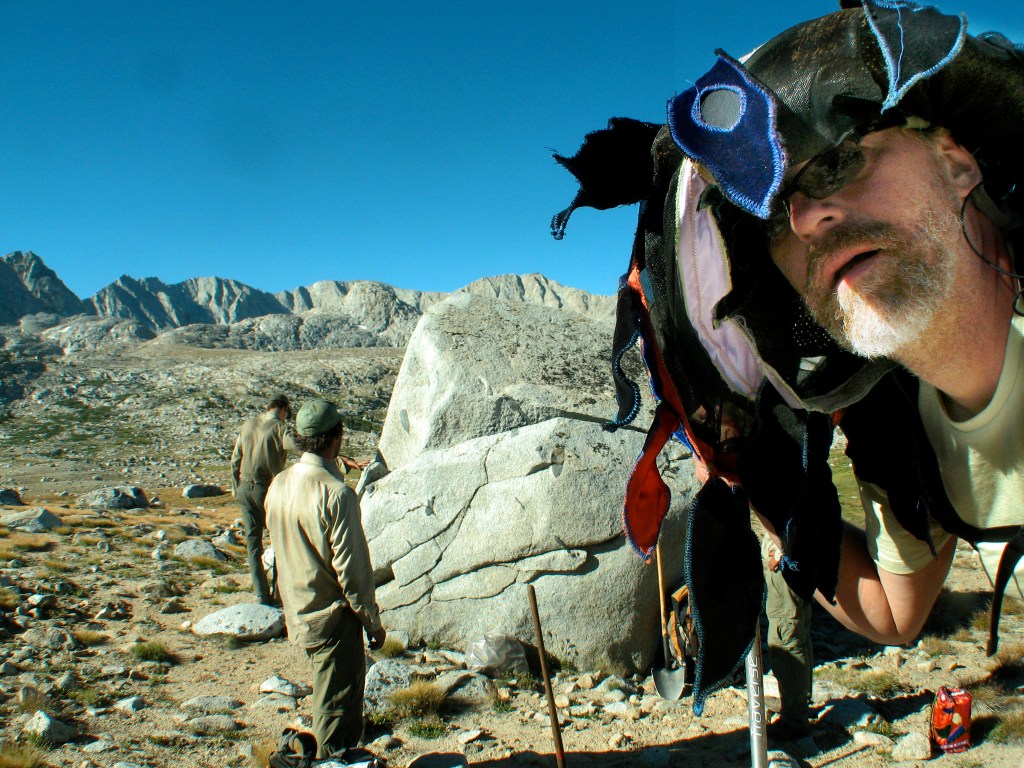
The second genre are those actions that transformed me and established an intimacy with my immediate presence with place, combining my physical activities, into a state of being, In these the same props were re-purposed. I walked and climbed swinging a bear-can containing a wind-chime it’s muted tinkling a direct response to my movements negotiating pathless turf and terrain. I contemplated my absurd headdress as an otherworldly cairn as it marked temporally my presence upon a place– watching the wind animate the queer object as it would any flora or fur.
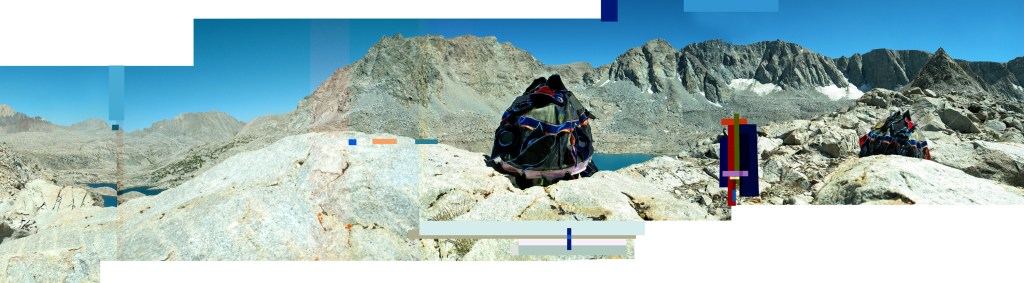
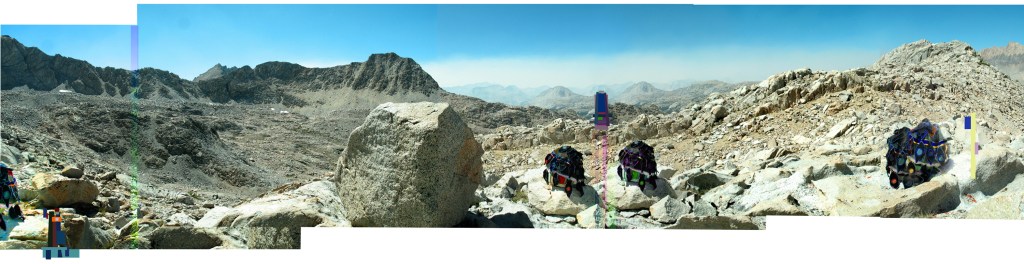
Both genres now exist as document only, objects and images presented that only elude to a multifaceted experience, marked by a physical activity and space, and inclusive of a schism deriving from being both rejoined and reminded I am now & forever alien to wilderness.
To experience these documents in a gallery setting you are invited to swing the Chime-Can and wear the Kotwa Banner. Shift the Banner’s carabineer to your own belt. Dangle the Chime Can above ground features, and gently swing the can back and forth–dress yourself in headdress or loincloth and know that these things are both not and are the performed gestures of the Kotwa project just as the panoramic photographs are only approximations of the vistas, and environments in the Sierras. Your motions are yet transpiring within physical space and inseparable from local environment but like for me the art mark is not made upon or with this material—Through process and event, physical force and dream allow place to sculpt and reveal your I.
Aldo & Leonardo, a partnership between Colorado Art Ranch and the Aldo Leopold Wilderness Research Institute, is a project to celebrate the 50th anniversary of the Wilderness Act. The project is inspired by the scientific wisdom of Aldo Leopold and the artistic genius of Leonardo da Vinci. Our endeavor is an interdisciplinary collaboration of artists and scientists designed to celebrate the lands, resources and opportunities protected by the Wilderness Act. In 2013, One-month residencies were hosted in six diverse wilderness areas for 18 invited artists. Artists worked alongside wild-land research scientists and gained firsthand knowledge of the wonders, complexities and challenges of our nation’s wildest places. Collectively the results creatively illustrates the value of wild areas and honors the scientific efforts to preserve wilderness for the next fifty years.
http://aldoandleonardo.blogspot.com/2013/11/interview-with-artist-duane-mcdiarmid.html
Where are we? …the final leg of the drive is 27 miles on a one lane winding through a Zen garden of bare rock and knarled trees (there is no garden architect, beyond the desire for a tree to split a stone in order to live, and a lichen to parasitically attaché to a host to rob nutrients). The road climbs and crosses passes at over 9000 feet hangs on ledges barely as wide as the car, climbs and curves so sharply that at times you can see no earth beside nor ahead only the hood of the truck and sky I must lean out the window to confirm there is something out there to drive on.
I have never traveled so slowly by car where 10 mph is something you slow down from, where you drive and drive somemore and do not yet arrive at places just 4 miles away
—a black bear flies into the road at dusk a vague bat like black shade of geometry that you only see as after image and rustling in the growth from where it sprang and where it disappeared.
I read somewhere that the sierras are the fastest growing mountains in the world and the fastest eroding too—there is a muddy paw print above the shower and claw scratches in the shared bathroom wall near the ceiling—bears like the smell of shampoo and soap.
There is no phone service no internet—it takes 2-3 hours one-way to reach these services—there is a volunteer at High sierra who has a two way radio but its over a half hour to there…that is where we will head in the not too distant future when the valley fills with smoke and the sky turns peach and pale tan flirting with a value 2 neutral grey.
powers and pressures—increments and sudden shifts are all around—as is the breath in meditation & exertion and potentially in panic. My fellow artist Tory Tepp and I have been lent Forest service Bear Cans – the destruction proof kegs a bit bigger then a large coffee can that hold and protect food from hungry bears—the problem is immediately space –the food we have laid out on the counter and table will never all fit in the cans—we work the puzzle again and again laughing at the dire reality that all our meals just wont fit into the can—we will need to carry fewer calories—and we squeeze and mold our food to pack tight the cans—I remember being told that your stomach is the same size as your fist—

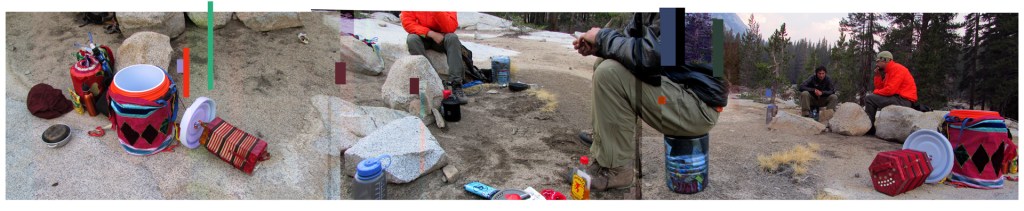
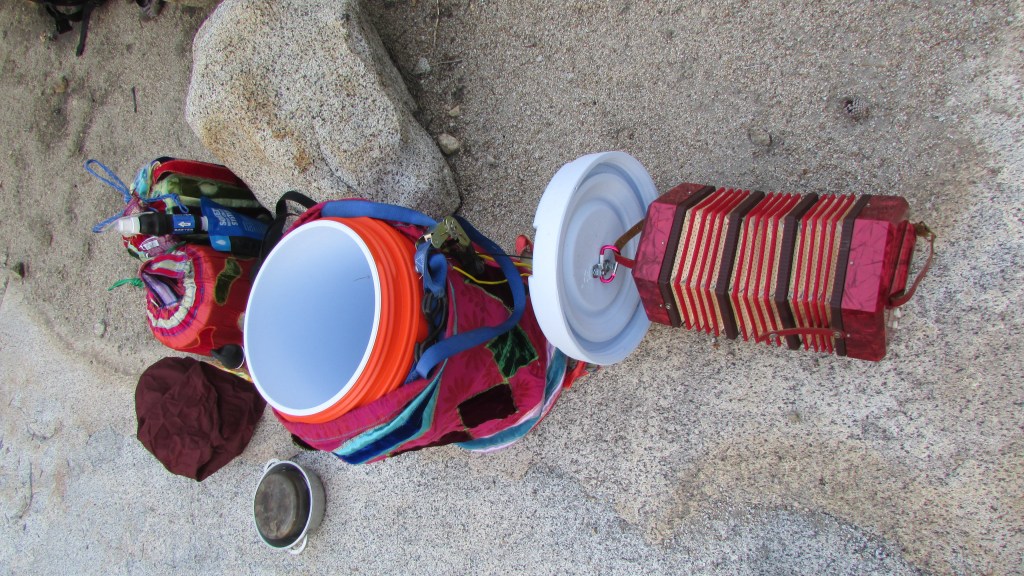
Now I think of a fist per meal and readily see that my bear can, can not provide the fist to stomach ratio multiplied by the days and meals—Tory and I grow increasingly nervous chatting and contemplating the ‘can problem’ and its off-spring—the bear cans are feeling pretty heavy… too heavy we joke to relieve our tension—can we actually do what we have agreed to do—this walking lugging climbing working task—are we up to it?
You apply for exciting opportunities in the arts needing to some how break through the competition—you make claims about your fitness and readiness—during your ph interview as a finalist confidence abounds you nonchalantly assure all – but really it has been 20 years since you backpacked at this level and never at this elevation for an extended period—you are an over 50 yr old educator, you are an artist—the thought can I do this really has come pretty late in the game. Tory points out that we can beg for mercy—we imagine Sara our crew leader—we have not met her: all we know is she works as a wilderness ranger and has hiked all three of the transcontinental trails—we are feeling intimidated—luckily we have a watermelon to offer in the morning to start off in good graces. Bear cans finally packed into packs we add all our other gear—simply everything we will need have or use for the next 8 days and—Tory and I have known each other about 48 hrs and decide to share a tent for 8 nights to cut the total weight—
From this launch pad we will go on foot on our initiation trek eight days 50 miles and through a series of ascents that are equivalent to a mile straight up—most of the time we carry all our gear food supplies –having carefully considered the weight of each item—then at the trail head we add, a six foot steel crosscut saw, an axe, two pruning loppers, a hammer, two crow bars, two shovels—and a one man saw—4 hard hats—these too are added to the packs before we begin—I laugh remembering I was once told to cut off the handle of my toothbrush and take the tags out of t-shirts to cut weight as I grapple to tie on my share of our tools. We will not simply be hiking and climbing this is a work mission we are grunts clearing trail, cleaning litter, learning this vast site—thinking about art squeezes in, in the evening and occasionally blinks into the experience while we’re on the boot.
The real expedition is the remainder of 30 days when as the artist-self we author and embark on the next journey

Love poem to place – Tory Tepp found a carried a heart shape piece of stone for her from from Italian lake a glacial lake we reached with difficulty. Tory was my fellow artist on the Sierra site–simultaneous to the wilderness residency experience he was also experiencing struggles in his romantic life– the trail creates intimacy–I wrote this feeling solidarity with him and the woman he clearly loved that like the mountains we were in I didn’t know–combining his and my experiences with love and mountain places–
I have traversed your green skin and reflective places
seen the purple stars alive in your depths
you in the shadows
lying still you are transparent to the strewn rocks at your bottom—
and when glittering
with sun
as opaque as basalt
wind waves and tectonic grinding build and drop as lovers breaths
panting hard and climbing as they press inward to where old cedars count
through our generations
eyeless watchers of
tossed stones
bone knives blessed with animal spirits
daquiries spun in a blender
all of it mere blinks
whole islands come and go—and so does the rare albino bear
storms are whispering away centuries
and you remain frail and hard as a lash
butterfly tickles and blister strikes
 duane mcdiarmid