(we are all responsible—my story)
Laws of nature fold the earth—physics
Laws of man tilt the playing field—economics & politics
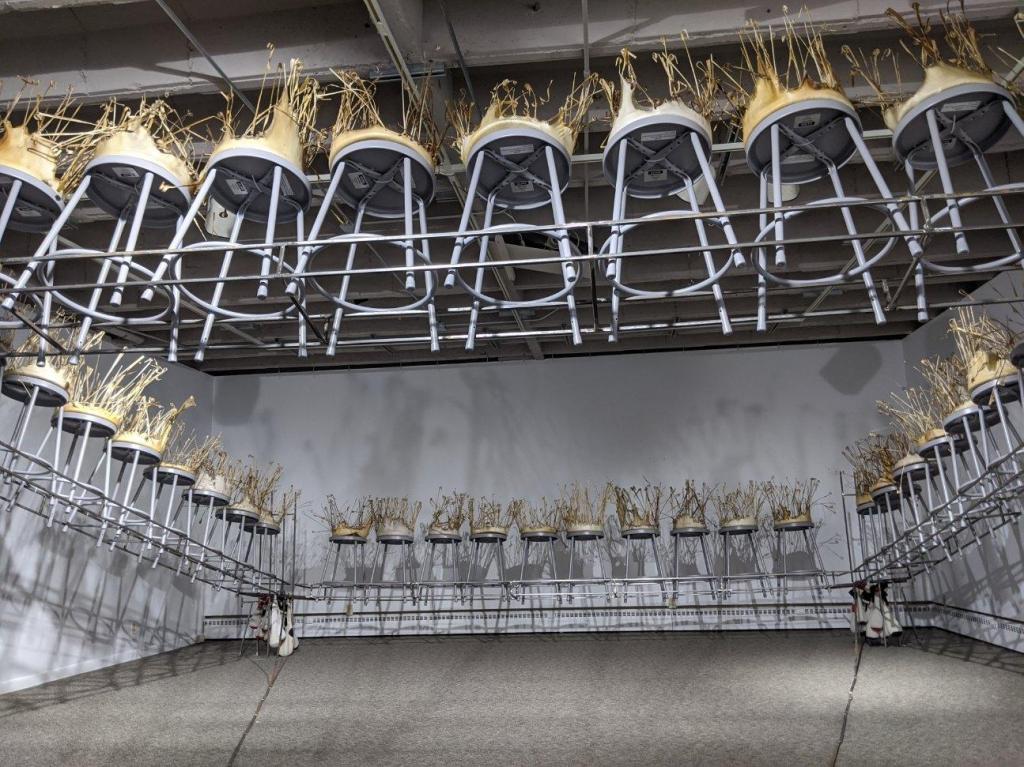
My family moved to Mankato MN in 1968, I was seven years old. A massive stone marker stood by the only bridge into town One could not miss this Marker–it read: Here were hanged 38 Sioux Indians, Dec 26 1862
In junior high school I visited ‘old folks homes’ with a tape recorder to learn local history. I spoke to a woman who told me that after her grandparents died, her father and his sister, who were children at the time, were taken in by the neighboring farmers—an Indian home where they were raised. She said her father was later in the Navy and fought for Lincoln in the Civil War. Her father learned how to tie knots.
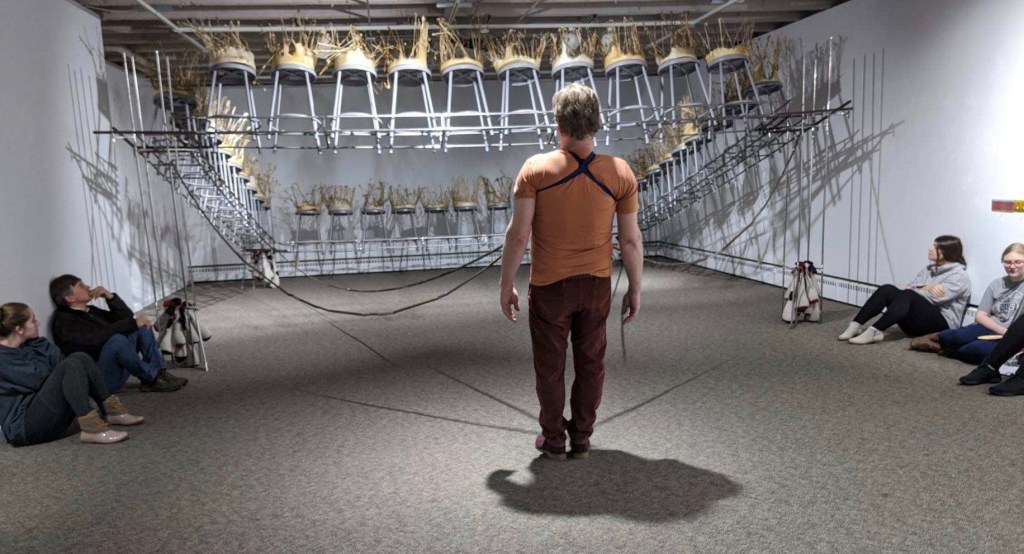
A Dakota man goes into a store, The allotment from the government has not been paid, he has no money, he tells the merchant his family is starving. The response is: …then let them eat grass—or their own dung
In 1862 The U.S. government failed to make on time its payment to the Dakota. The Dakota were unable to make purchases of food, supplies and equipment from the white traders their loss of land through treaties had made them dependent upon–slowly starving, options were few.
…The Dakota signed a series of treaties that incrementally ceded all but a narrow strip of their lands along the banks of the Minnesota River in exchange for peace and annual payments. But harvests were inadequate—many rejected assimilation and attempted to continue to live as hunters. Deforestation and settler hunting depleted game and fur animals. The Dakota had too little to eat, too little to trade.
Dakota society was complex. Many had cut their hair and adopted White ways of dress, they lived in houses and farmed. They married white people, had families, neighbors, friends, had formed mixed communities.
I learned in school that stories have beginnings middles and ends. … Conditions create wars more then incidents, there are recorded incidents–stories – perhaps they are true. Conditions have no beginning, do not end—they emerge from cause, causes that have emerged from a former set of conditions.
A hunting party goes off the reservation, and are unsuccessful at finding game–they come across a white owned farm, find in a chicken’s nest an egg—there is an argument as to whether to eat the egg—one’s manhood is questioned –you are weak and afraid to even eat the egg of this white man—I am not I will show you -I will walk to the house of this white man and kill him.
Elsewhere some whites are having a party, they invite some Dakota to join them—there is drinking, drunken challenges and target shooting games are played–there is an accident involving a gun and a white man dies
The Dakota believe their young men will not get a fair hearing for the egg incident, for the death at the party—leaders are reluctant to surrender the young men to white authority. Many Dakota are pressing leaders to go to War—The young men say the whites are weak so many of their men in the south fighting for Chief Lincoln and the Union. Dakota leaders know they cannot win against the whites. Some have been east and seen that the whites can send more and more.
The early Days of the war go well for the Lakota, several rampages are successful yet many whites are warned by Dakota friends and relatives and are able to flee. Some are protected and led to safety by Dakota.
The merchant is found dead his mouth stuffed with grass.
An immigrant working with a scythe in his field stops, offers his hand to shake to a man who stabs him in the stomach.
The soil south of Mankato in Blue Earth county is so black it looks like navy blue velvet when the sun hits it—it is perhaps the richest soil in the world and it belongs by treaty to the Ho-Chunk. The Dakota hope the Ho-Chunck will join them—They hope their traditional enemies, the Ojibwe, will rise against the whites in the North, and together they will drive the whites out. But the Ho-Chunk do not. The Ojibwe do not go to war. Many Dakota bands also do not join the war—Some instead fight for the lives of Settlers.
In Mankato the FBI comes to my House, My parents have not paid a portion of their taxes—the war tax funding the Police Action in Vietnam. While my mom prepares their coffee in our kitchen the FBI tell me that my Mom is going to jail. I am eight or nine years old and cry—my mother throws those guys out of the house.
During lunch at school older boys watch a T.V. rolled in on a cart, they are watching Draft numbers called up. Some have already gone to Canada, some to Vietnam by the Draft others choose the war.
I listen to the radio to cities and bases falling—Hue, DaNang, Nha Trang, Cam Ranh, Da Lat, and then Siagon.
My mother is not sent to jail.
The Dakota do not win, A large White Army is sent. They have cannons. The Dakota give up their prisoners.
303 Dakota are sentenced to death by U.S. military courts who spend as little as 5 minutes on a case, — Abraham Lincoln signs the death warrants for 39, one is later spared.
The woman in the nursing home tells me her Father tied the nooses, because he knew knots from the Navy and was told if he didn’t “someone will tie 40” .
38 are hung in a mass spectacle before a crowd of 4000 onlookers—the bodies are buried in a mass grave—but almost immediately in the night, a majority are dug up and hauled away by medical doctors and souvenir hunters.
Nearly 2000 Dakota are imprisoned outdoors over the winter in a concentration camp. Winters are cold in Minnesota. This land later becomes a Mankato city park.
The Dakota and Ho-Chunk are dispossessed of all their lands and exiled from Minnesota—including warriors that took up arms against fellow Dakota to protect whites.
I am bound to these events sculpted by place and history
 duane mcdiarmid